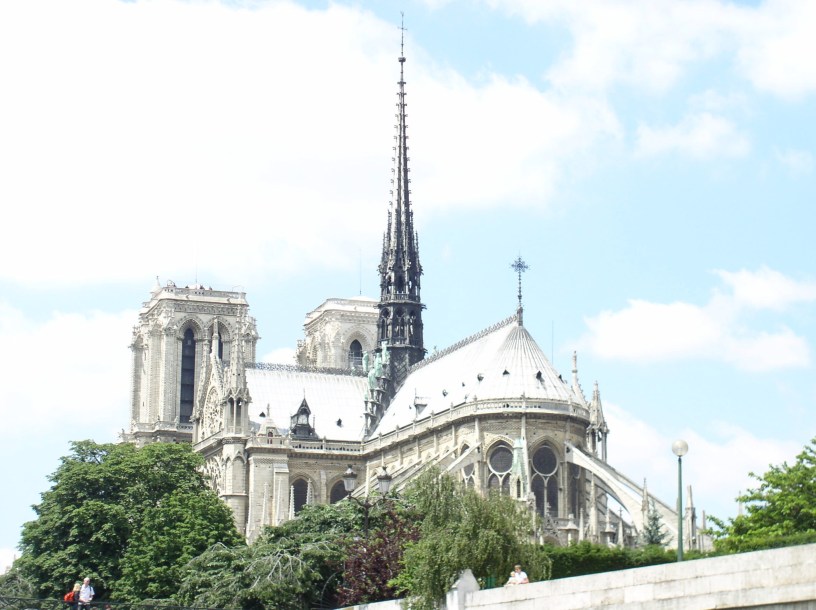
When news first broke, it was shocking. The Notre Dame de Paris, the cathedral of Paris, was on fire.
I’ve had the pleasure of visiting the cathedral three times over the course of about five years. But I must confess, I wish I had taken more time to explore and marvel at its beauty. For those that have never been, a great opportunity has been lost.
Although much has been saved, including the mesmerizing rose windows, much of the stained glass windows in the sanctuary and the crown of thrones, the cathedral itself will never be the same. The 850 year old roof is irreplaceable as the centuries have diminished trees of such height and quality from the country. The stonework and masonry knowledge that helped build the ribbed vaulting, which was the only thing that kept the building from completely collapsing, has been lost to history.
France’s President Emmanuel Macron has vowed to rebuild it in five years. It is an ambitious goal, and one that France may not be achieved. As Notre Dame has watched the city of Paris grow and change, so has the understanding of how to build such an impressive structure. Architects and historians have a tough road ahead.
There is much speculation about how the fire started and who is responsible. At this point, most evidence seems to indicate an accident. The loss is tremendous, but also demonstrates the challenge of maintaining such buildings. Each time I visited the Notre Dame, it was always in the process of restoration. When I was there it was the square bell towers. Before the fire, restoration crews were working on the now fallen spire and trying to shore up some major cracks that were forming, which indicated that the building was facing some severe structural problems. Many historical sites throughout Europe struggle with the same challenge. The passage of time and human action often do the most damage to historic structures than world wars (though they do their fair share of damage as well).
So if you are planning to travel to Europe, or anywhere in the world where you will visit historical monuments, consider donating to their upkeep. When I traveled around Europe, I would often drop a couple of Euros in the donation jar for the upkeep of the church or castle I had the privilege of enjoying, even if just for a few minutes, so it would remain open for the community and other weary travelers.
The other act of courtesy that tourists can employ is to avoid touching anything that has been designated off limits. It might be fun for a moment and make a great picture, I know someone who touched a painting in the Louvre, but in the process you could damage the artifact or monument in pursuit of the selfie or that one in a million shot. Trust me, that piece of art is priceless, but the fine or jail time you might receive for such an act is not worth the price.
Finally, DO NOT put your name on anything except the guest book. At Versailles, I remember seeing people who had etched their names in mirrors that were hundreds of years old and being frustrated by their lack of respect for the people who may have spent their entire lives creating them. In the process of foolishly putting “I am here” on something was made several centuries ago, instead demonstrate your dedication to preservation by relishing in the beauty of history without destroying it in the process. One of the worst instances of this was a tourist from China who carved his name on an ancient Egyptian statues in Luxor. It was a shameful display, but unfortunately it is rather common.
The Notre Dame de Paris is not lost forever, but it will never be the same. The majesty of the cathedral has been dimmed in the wake of the fire that consumed everything in its path. But not all hope is lost. The cathedral still stands and the light of the cross on the alter has not diminished. The Lady of Paris will return, likely stronger and more beautiful than ever.
 History with Brittany